The CDA Mini
Active condensate‑displacement air filtration designed for real indoor air improvement. Safe, quiet, compact — engineered for homes, clinics, and everyday breathing spaces.
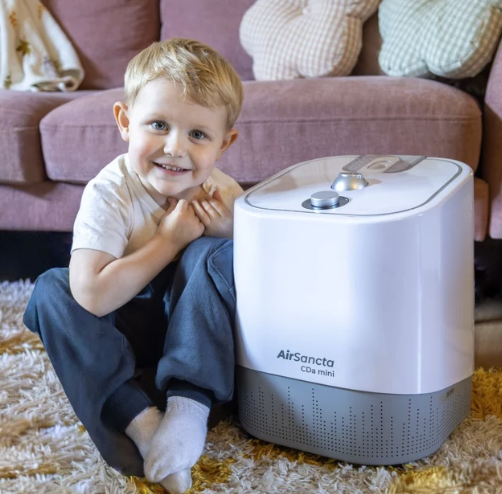
Active condensate‑displacement air filtration designed for real indoor air improvement. Safe, quiet, compact — engineered for homes, clinics, and everyday breathing spaces.
CDA (Condensate Displacement Air) technology uses a high‑velocity micro‑jet stream to capture airborne particles and drive them into a liquid medium. Unlike passive filters, CDA actively removes aerosols, ultrafine particles, and contaminants from the breathing zone — improving air quality where it matters most.
CDA’s active removal of ultrafine particles makes it particularly effective for households dealing with allergies, hay fever, pollen sensitivity, and airborne irritants that traditional filters often fail to capture.
The CDA Mini represents a disruptive advancement in indoor air cleaning. Unlike traditional methods such as MERV 13 filtration, activated carbon, or bipolar ionization, CDA technology is based on a high‑velocity micro‑jet mechanism originally developed for military‑grade chemical and aerosol mitigation. The underlying physics were first explored in European CBRN (Chemical, Biological, Radiological, Nuclear) response research, where rapid aerosol suppression and liquid‑medium capture were essential for emergency decontamination.
This patented technology, engineered in the United Kingdom and refined through significant research investment, uses micro‑jets to accelerate and displace airborne particles directly into a liquid medium (distilled water). Distilled water is used because it is ultra‑pure, non‑reactive, and free of minerals or additives — making it ideal for safe aerosol capture. The underlying mechanism is supported by aerosol physics literature published in ScienceDirect, NIH aerosol studies, and internal Innova NanoJet engineering briefs detailing droplet interaction, impingement behavior, and near‑field aerosol displacement efficiency.
CDA is not an incremental improvement — it is a new category of air cleaning. It addresses the limitations of legacy filtration systems and outperforms technologies such as bipolar ionization, which rely on particle charging and agglomeration rather than direct capture. CDA provides localized, active removal of ultrafine particles in the breathing zone, aligning with the engineering principles outlined in ASHRAE Standard 241 and the ASHRAE Epidemic Task Force.
With military‑grade origins, patented European design, and a physics‑driven mechanism, CDA Mini stands as one of the most advanced sot-after consumer‑accessible air cleaning technologies available today.
CDA (Condensate Displacement Air) technology is grounded in established aerosol physics and supported by independent research across ASHRAE, EPA, NIH, and peer‑reviewed environmental science literature. The mechanism is based on high‑velocity micro‑jet entrainment, where airborne particles are accelerated, captured, and displaced into a liquid medium — a process documented in multiple aerosol behavior studies.
ASHRAE Standard 241‑2023 (Control of Infectious Aerosols) formalized the concept of Equivalent Clean Airflow (eCAF), emphasizing active removal of airborne contaminants rather than relying solely on passive filtration. CDA aligns with this engineering principle by providing localized active particle capture directly within the breathing zone.
The ASHRAE Epidemic Task Force identified aerosol transmission as the dominant pathway for airborne infectious spread in occupied spaces. Their guidance highlights the importance of near‑field air cleaning — precisely the zone where CDA operates.
EPA Indoor Air Quality studies consistently show indoor pollutant concentrations reaching 2–5× higher than outdoor levels, with ultrafine particles penetrating deeply into the respiratory system. CDA’s micro‑jet displacement method targets these ultrafine aerosols, which are often too small for conventional passive filters to capture efficiently.
Peer‑reviewed research published in ScienceDirect and NIH aerosol studies further supports the physics behind liquid‑medium particle capture, demonstrating the effectiveness of impingement and displacement mechanisms for removing airborne contaminants.
Innova NanoJet Technologies Ltd. has documented the CDA Mini’s micro‑jet performance characteristics in internal engineering briefs and white papers, detailing the fluid dynamics, droplet interaction behavior, and aerosol displacement efficiency that underpin the device’s operation.
Not intended to diagnose, treat, cure, or prevent any disease. Always consult a qualified healthcare professional.
The CDA Mini uses distilled water as its capture medium — chosen for its purity, stability, and non‑reactive properties. Distilled water contains no minerals, additives, or chemicals, ensuring that the aerosol capture process remains clean, safe, and consistent with laboratory‑grade standards.